Every colour that exists in fashion, beauty, design or print comes from mixing three primaries: cyan blue, magenta red and primary yellow. Everything else follows.
Colour analysis is the anchor point of physical image consulting. It is often the most striking diagnosis of all: it reveals your image naturally, without artifice, yet very powerfully.
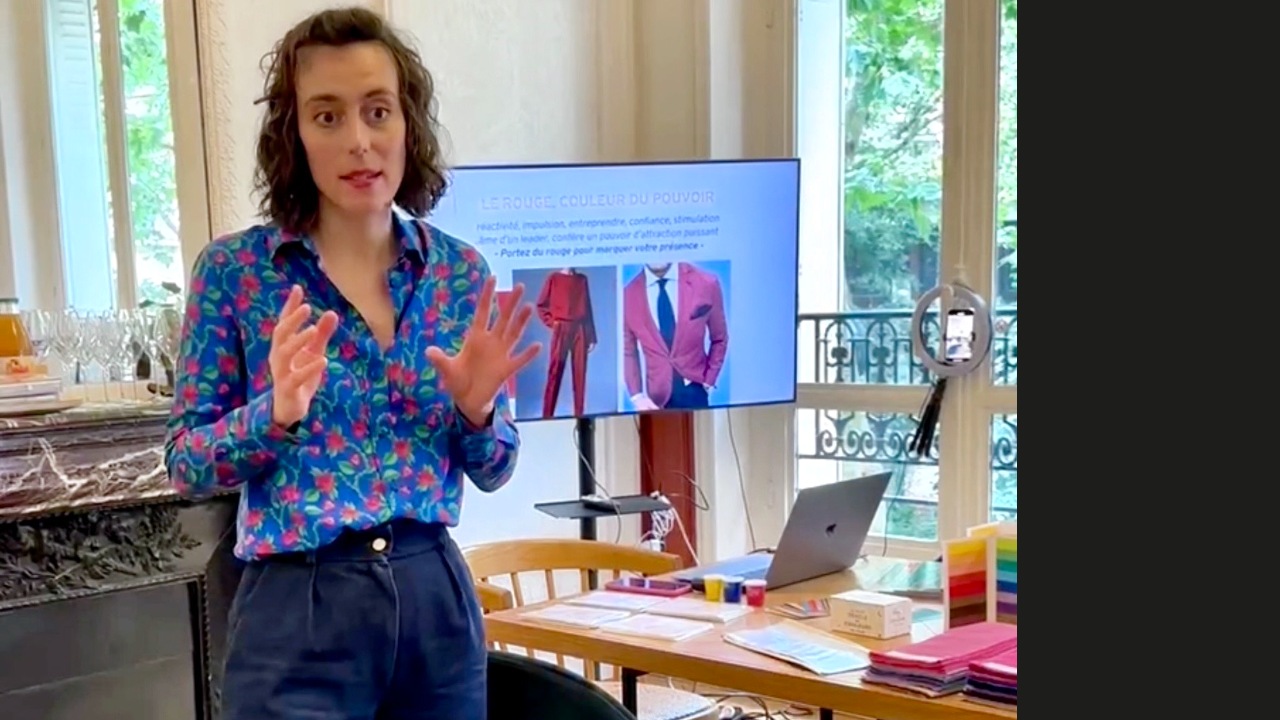
Brune Constancia, image consultant and expert in our network, singles out red for anyone who wants to assert their authority: a powerful colour that catches the eye and stays in the mind after you speak. Well judged and well chosen in its shade, it gives presence without raising your voice. The question is which red serves you, and that is where a diagnosis becomes useful.
The principle: hold successive palettes against your complexion and watch what each one does to your face. More than two hundred fabrics near the face. Some shades hollow the features, others light them up: it is all visible in the mirror, and it determines your colour season — spring, summer, autumn or winter.
The outcome is a personal colour chart for each participant. More than twenty-four colours chosen for her, to keep for life. Invaluable for clothing, make-up and accessories, and more broadly for everything that carries her image.
A concrete case
Consider a digital brand palette built in correlation with your personal colour analysis. The same colours on you and on your materials: one coherent, powerful 360° signature.
We think a degree closes something. It only opens the way to a lasting career, provided you keep learning.
After my specialised Master at business school, I took a university diploma in entrepreneurship, then conference cycles at the Sorbonne. Not for the line on the CV: to keep thinking and learning. Once your studies are behind you, you have the luxury of choosing precise specialities to broaden your skills, and that is valuable.
A French university diploma is issued by the university itself, and that is precisely what gives it value: on a CV, the faculty’s name stands behind your training. It can be taken alongside a job, in almost any field, without starting over.
Conference cycles bring together recognised experts over a full semester, on site or remotely. Few people know they are open to everyone.
Why this belongs to personal branding: expertise that stops evolving shows. In the way you talk about your work, in the examples you give, in the references you draw on. Learning is how you maintain what your image promises.
A concrete case
In 2025, ten public-speaking conferences at the Sorbonne for €90. Ten hours of exceptional teaching, for the price of a dinner.
Your CV is no longer the first document read about you.
Your interview starts before you walk into the room.
LinkedIn is the first network opened, in 94 % of cases. 55 % of recruiters running those searches have already found grounds to rule a candidate out. And 21 % rule out a profile with no online presence at all: silence is a message too.
For an entrepreneur or a company leader, the same mechanism applies, with an invoice at the end of it. 70 % of decision-makers have questioned their current provider after reading a competitor’s content. While you are not publishing, your client is reading someone else.
60 % accept paying more to work with someone whose thinking they have read. 74 % of French people rate a company more highly when its leader is visible. And a leader’s personal brand weighs twice as much as company communication when it comes to attracting clients and talent.
Your online image is not an add-on to your communication. It is the first document people read about you.
Sources: Agence Troisvirgulecinq via HelloWork for the 94 % · Express Employment Professionals and The Harris Poll, 1,005 hiring decision-makers, for the 55 % and 21 % · Edelman and LinkedIn, B2B Thought Leadership Impact Report 2024, for the 70 % and 60 % · Reputation VIP 2021 for the 74 % · Edelman Trust Barometer 2022 for the weight of personal branding.
Tonight’s test
Type your first and last name into Google in private browsing, then open LinkedIn the way a stranger would.
One tenth of a second. That is how long it takes for someone to form an opinion of you. More unsettling still: looking longer does not change their judgement, it only makes them more confident in it.
The judgement is already made. Competence, confidence, likeability: all of it is assessed before the first word. What follows only confirms or corrects, and correcting costs far more.
Everything comes down to details. The cut, the fabric, the care, the framing of a profile photo. These are not aesthetic details: they are information you send without having chosen it.
Colours speak before you do. In person as online, colour is the first signal received; it sets an emotion before your name has been read.
Standing out is a strategic choice, not a risk. In a room where everyone wears black, the right colour is enough to make you exist. The real risk is the opposite: being interchangeable. It has to be your colour, the one that shows you at your best rather than disguising you.
Source for the tenth of a second: Willis, J. and Todorov, A. (2006), First Impressions: Making Up Your Mind After a 100-Ms Exposure to a Face, Psychological Science, 17(7), 592-598, Princeton University.
The exercise
Show your profile photo to three people who do not know you, and ask for three words. In five minutes you will know what your image says before you do.
Personal branding works at 360°, never in fragments.
Six levers to work on, from the web to real life. Personal branding at 360° is two halves answering each other: what the web says about you, and what you convey in a room.
One prerequisite: none of these levers works without introspection and a settled positioning. Knowing yourself better is step one, the one that makes a personal brand aligned rather than manufactured.
The digital image first. Online reputation and search: what comes up when someone types your first and last name into Google? You need to hold the first positions with quality results. Run the test in private browsing, or your history skews what you see.
Then digital identity — emblem, graphic guidelines, professional photos and video. Then digital communication: holding your audience’s attention, growing your visibility on social media, through a website, and why not through your own media.
The physical image next. Storytelling and verbal communication: build your narrative, then assert it through public speaking. Storytelling comes out of introspection, and that is where the two halves meet.
Non-verbal communication: a presence that holds a room, posture included. And style: the colours that show you at your best. Colour analysis is one of the most powerful levers, it changes perception at first glance.
No such thing as fate
Many namesakes, or a public figure holding the first positions: there are always ways around it. In personal branding, nothing is set in stone.
Three stages, in an order that is not negotiable. You do not start with a logo or with LinkedIn: you start with yourself.
Know yourself better. Clarify your goals and your audience, reveal who you really are, identify your strengths. Nothing gets built before this stage.
Make yourself known. Build your personal communication strategy, online and offline, in writing and in speech.
Be recognised. Grow that strategy over time, and make your personal brand signature last.
Two questions always come up. Do you need to be visible already? No: a blank page is faster to work with than an approximate reputation to correct. How long before it shows? Foundations take three to six weeks; perception shifts over one or two quarters, provided you keep the rhythm.
Process inspired by the work of P. Baumeister. “A personal brand must be discovered, reinforced and consolidated,” William Arruda.
The order not to reverse
Introspection, positioning, then creation. Graphic guidelines built before the introspection are decoration: well made, and unrelated to you.
Visibility is often mistaken for frequency. An executive who comments on everything ends up associated with nothing. A territory of expression is defined as much by what you decline to comment on as by what you defend.
Four public statements a year, held on the same ground, build an authority that a daily stream of opinions dilutes.
The takeaway
List the three subjects on which your word carries weight: it is the hardest exercise of an engagement, and the one that changes the most.
Client case · Online reputation
M. L., head of a consulting firm: taking back the first page.
At the first conversation: on her name, the top three results pointed to a company she had sold, and her most visible photo was seven years old. Nothing damaging, simply a story that was no longer hers.
The work came down to three levers: reordering what surfaces, producing a photo series consistent with her current posture, and setting a territory of expression held on a single subject. Six weeks, without a single line of invented content.
What it teaches
Online reputation is not cleaned, it is reordered. The past remains, it simply stops arriving first.
Visual identity
Your professional photo costs more than you think.
A shot cropped from a wedding, a cluttered office background, neon lighting: every detail sends information you did not choose. And statistically, that image is the first thing anyone sees of you.
A well-prepared session is not about flattering you, it makes who you are in a meeting match what people see on screen.
The takeaway
A photo must last three years, work in black and white, and stay legible at forty pixels.
Client case · Public speaking
A. G., founder raising a round: preparing a talk that commits.
The pitch held technically, but it described a product where the room was waiting for a conviction. The work was not on the content, it was on the order of ideas and on what had to be said first.
Two storytelling sessions, a three-minute outline, and one rule held ever since: never open on the solution.
What it teaches
A pitch is judged on its first sentence. If it describes what you sell, it is already late.
Online reputation
An investor’s first reflex is to search your name.
Before the deck, before the numbers, there is a search on your name. What comes up is almost never what you would have chosen to show.
An audit does not erase the past, it reorders what people find first.
The takeaway
The test takes two minutes: search your name in a private window, and read the first page as if you did not know yourself.